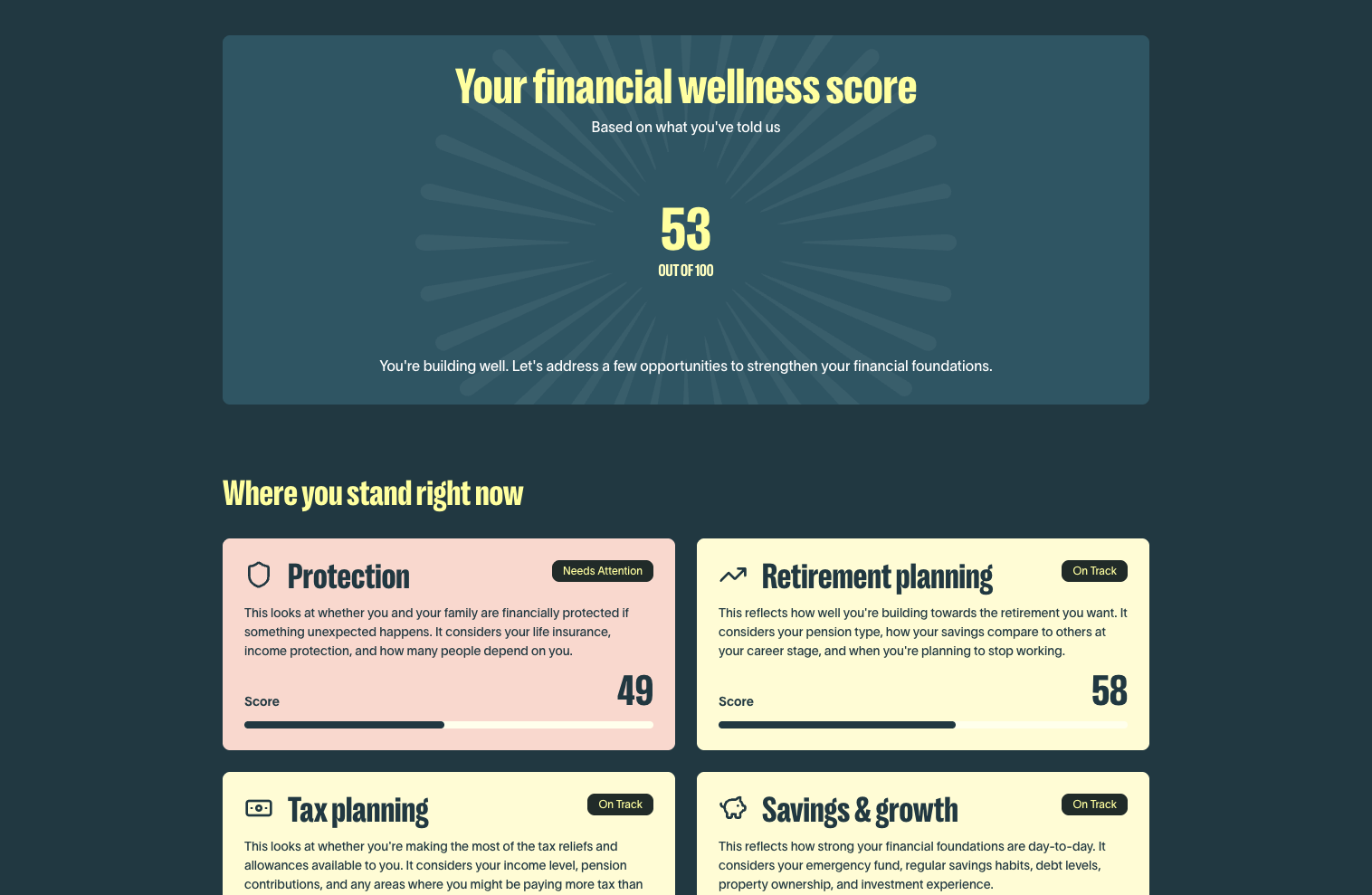
Wesleyan needed a way to help prospects understand their own financial position and be signposted toward the products that actually fit them. As a financially regulated mutual, the constraints were real: what the tool can and can't say, how decisions are made and evidenced, and how content changes are governed all mattered as much as the build itself. It went from kick-off to delivered in around six weeks.
What shipped
- Multi-stage financial health check form, built on SurveyJS, with save-and-resume and validation throughout
- A secure admin area built on SurveyJS Creator, letting business stakeholders author questions, answers, and branching logic themselves
- Rules-driven signposting to Wesleyan products, with logic owned outside the codebase
- CMS-managed content so copy and questions can change without a release
- Transactional email journeys for results and follow-up
- Full Azure data layer and pipelines, defined as code
Impact
- Time to market: ~6 weeks from start to delivery on a regulated product journey.
- Compliance-safe change: decision logic, copy, and the questions themselves are all auditable and editable by the business without engineering releases, which matters when wording is regulated.
- Self-serve question authoring: the admin area removed engineering from the loop entirely for question and branching changes, so compliance-approved wording could go live the same day it was signed off.
- Lead quality: prospects arrive at product conversations already segmented and better qualified.
My role & scope
- Led the technical delivery end-to-end: architecture, stack choices, and hands-on build.
- Designed the split between application code, CMS content, the survey definition, and the rules engine so each could be governed by the right team.
- Built the admin area around SurveyJS Creator, including the authentication and authorisation layer, so only approved stakeholders could publish changes to the live assessment.
- Set up the Azure infrastructure and Azure DevOps pipelines in Terraform.
- Used Claude Code and GitHub Copilot heavily throughout, both to build and to review. That was a significant part of how a six-week timeline was realistic.
Key decisions & trade-offs
- BRMS over hard-coded logic: Decision Rules.io kept the eligibility and signposting rules auditable and changeable by the business, at the cost of another system to manage. In a regulated context that was clearly the right trade.
- SurveyJS + SurveyJS Creator for the assessment: rather than hand-building the multi-stage form and a bespoke editor for it, SurveyJS handled the rendering, validation, and stage progression, while Creator gave the business a visual authoring UI for questions, answers, and branching logic. The survey definition became data rather than code, which is what made stakeholder-owned changes possible at all.
- Storyblok for content: let compliance-approved copy be updated directly rather than queued behind engineering.
- Next.js API functions on Vercel: fast to ship and simple to operate, with the heavier data and messaging concerns pushed into Azure.
- AI-assisted build and review: agents accelerated delivery, but every regulated path was human-reviewed. Speed didn't come at the cost of scrutiny.
See it in action


Tech stack
React, TypeScript, Next.js, SurveyJS, SurveyJS Creator, Storyblok CMS, Decision Rules.io, Vercel, Azure, Azure Communication Services, Terraform, Azure DevOps